
What makes a male brain? Sexually dimorphic circuitry in the Drosophila male CNS connectome
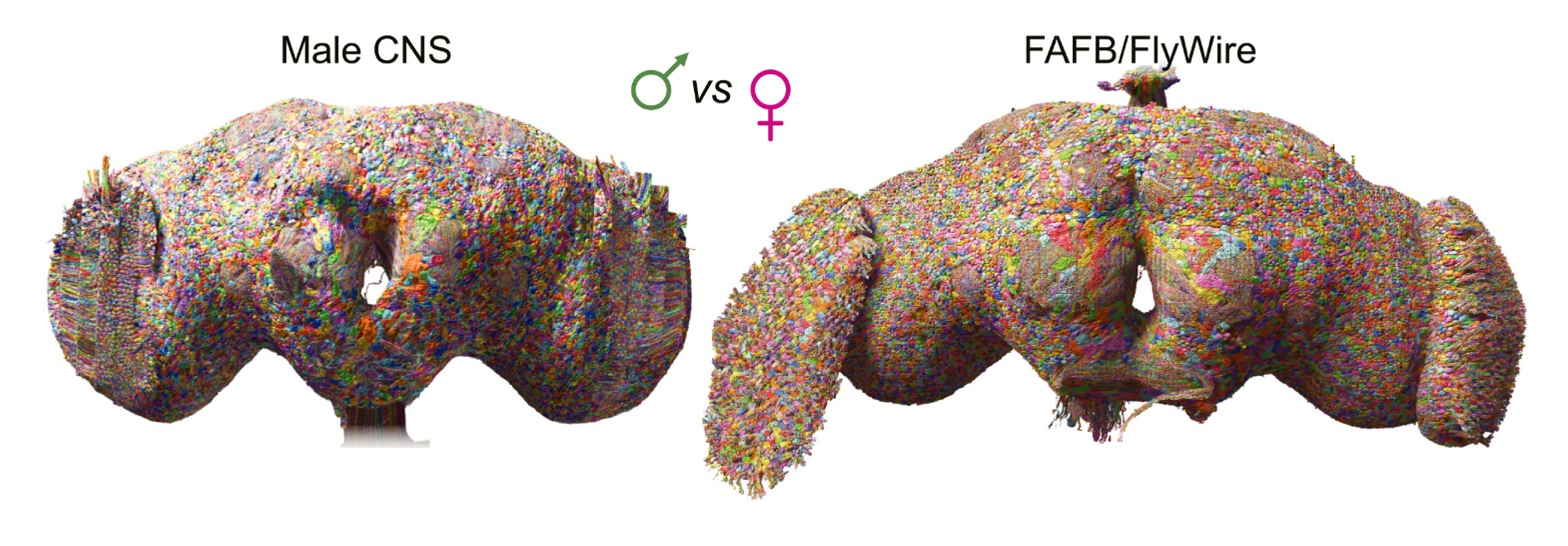
Over the past decade, connectomic analyses of the fruit fly Drosophila melanogaster have transformed our understanding of brain wiring. These tiny animals are mere millimetres in length, yet they possess intricate nervous systems capable of complex sensorimotor processing, decision making and behaviour. Researchers have mapped a single fly brain hemisphere (the “hemibrain” connectome [ref 1]), the complete brain and optic lobes (the “FlyWire” connectome [refs 2, 3]) and, most recently, the full brain and ventral nerve cord (the “BANC” connectome [ref 4]). Nonetheless, given the approximately 160,000 neurons of the fly nervous system, the sheer scale of connectome projects means that replication and comparison across individuals has remained a challenge. Each of the fly brain connectomes previously published has been female, allowing cross-dataset comparisons of neuronal wiring in genetically similar individuals. But what about the differences? For the first time, research teams from institutions including Cambridge University, Janelia Farm, Google, and others have mapped the complete central nervous system (CNS) connectome of an adult male Drosophila melanogaster [ref 5]. With this milestone, we can finally begin to understand how sexually dimorphic animal behaviours can arise from differences in circuit architecture.
To attract a mate, male fruit flies engage in an elaborate courtship ritual based around chasing, dancing and performing a “love song”: a series of rhythmic wing vibrations which increase receptivity in females. Combined with other sex-specific traits, including aggression, these behaviours are regulated at the genetic level by the key transcription factors fruitless and doublesex, which drive the formation of male-specific interneuron clusters in the dorsal posterior brain [ref 6]. However, understanding sexual dimorphism on the circuit level has remained a challenge. How much of the fly nervous system is consistent (or “isomorphic”) between males and females? Is dimorphism limited to specific behavioural circuits, or distributed throughout the CNS? And how do circuit changes correspond to differences in gene expression? To address this, researchers generated an enhanced focused ion beam scanning electron microscopy (eFIB-SEM) volume of the entire adult male CNS at synaptic resolution, then identified, proofread and annotated a staggering 166 700 neurons, 46 million presynapses and 312 million postsynapses.
In comparing this vast dataset to existing female connectomes, the team uncovered several key principles. First, despite genetic and behavioural differences, neuronal morphology and connectivity are overwhelmingly similar in male and female flies. By grouping neurons into cell types and matching these across datasets, we see that over 95% of Drosophila neurons are isomorphic, reflecting high connectomic stereotypy in individuals of both sexes. Second, sex differences are more prominent in the male brain than in the female. Roughly 1.4% of central brain neurons are sexually dimorphic, meaning that they are present in both sexes but show clear morphological differences. However, 3.4% of neurons in the male central brain are sex-specific (meaning that they can be matched across brain hemispheres but not across sexes), compared to only 1% of the female brain (see figure below, left). Third, sex differences in neuronal wiring correspond closely to fruitless and doublesex expression. Aligning the male and female connectomes with light-level gene expression datasets reveals that while only 7.4% of isomorphic neurons express fruitless and doublesex, this rises to 60.3% of dimorphic neurons and 90.4% of male-specific neurons (figure below, right). Finally, when we examine network connectivity across the CNS, we see that sexually-dimorphic and sex-specific neurons are concentrated in deep network layers within sensorimotor pathways, and are mostly localised to higher brain regions, suggesting that they predominantly influence integrative and decision-making circuitry.
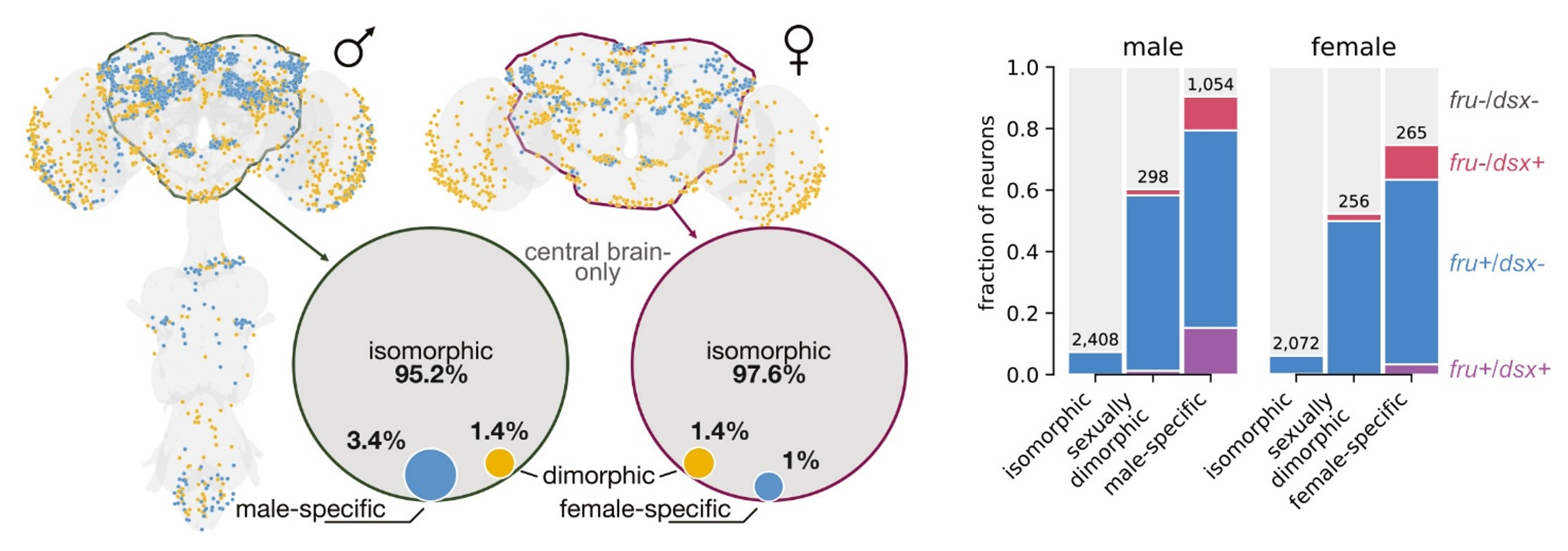
Sexual dimorphism in the Drosophila melanogaster CNS. Left, soma locations of sexually dimorphic (yellow) and sex-specific (blue) neurons in the male CNS and female central brain. Right, fractions of isomorphic, dimorphic and sex-specific neurons which express the key sex-related transcription factors fruitless and doublesex. Modified from Berg et al. 2026 [ref 5].
Of course, it remains to be seen how far sex differences in the Drosophila connectome can be generalised to other species. In the nematode C. elegans, the only other species for which complete connectomes exist in both sexes, male-specific neurons are again more numerous than female-specific [ref 7], which may indicate greater selection pressure on male behavioural traits. However, the organisation of Drosophila sex-specific neurons in deep network layers is not conserved in C. elegans**, leaving it unclear as to whether this pattern represents the exception or the rule. Furthermore, while sex differences in fruitless/doublesex expression provide a compelling case study in how genetic differences influence circuit connectivity, future work may yet link connectomic changes to specific gene variants associated with neurological disorders.
At Aelysia, we are always excited to be part of projects that open new frontiers in research. Comparative connectomics necessitates expert proofreading and careful attention to detail, and we were delighted to support the Male CNS connectome project. We proofread specialist cell types including Kenyon cells, olfactory sensory neurons and dopaminergic neurons, in addition to bridging difficult regions and artefacts in the dataset. We are very proud of the entire team involved with this project, and we know that the Male CNS Connectome will be an invaluable resource for researchers in years to come.
For now, the internet is making it play DOOM.
References:
Scheffer et al. (2020). A connectome and analysis of the adult Drosophila central brain. eLife doi.org/10.7554/eLife.57443
Dorkenwald et al. (2024). Neuronal wiring diagram of an adult brain. Nature doi:10.1038/s41586-024-07558-y
Schlegel et al. (2024): Whole-brain annotation and multi-connectome cell typing of Drosophila. Nature doi:10.1038/s41586-024-07686-5
Bates et al. (2025): Distributed control circuits across a brain-and-cord connectome. Nature doi:10.1101/2025.07.31.667571
Berg et al. (2026): Sexual dimorphism in the complete Drosophila male central nervous system connectome. Cell doi:10.1016/j.cell.2026.08.015
Kimura et al. (2008): Fruitless and Doublesex Coordinate to Generate Male-Specific Neurons that Can Initiate Courtship. Cell doi:10.1016/j.neuron.2008.06.007
S.J. Cook et al. (2019). Whole-animal connectomes of both Caenorhabditis elegans sexes. Nature doi:10.1038/s41586-019-1352-7
