
The Brain-and-Nerve-Cord (BANC) connectome: how behavioural control is distributed across a nervous system
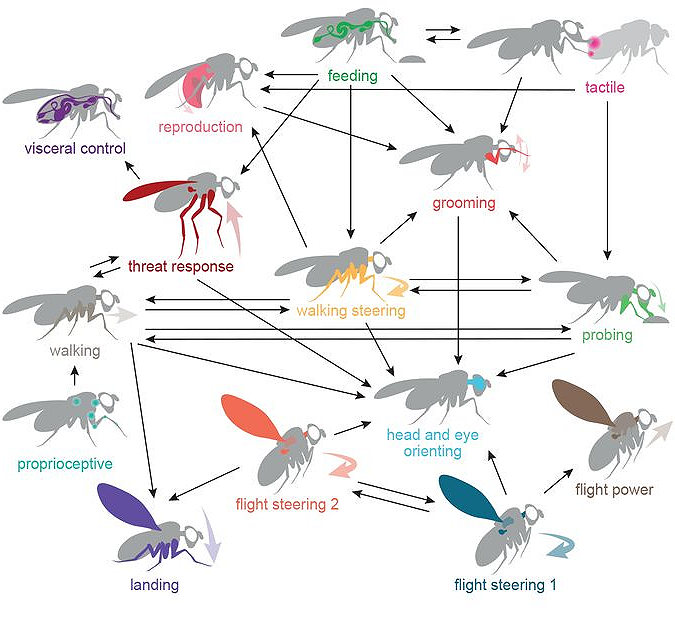
We are very excited to share the results of one of our most ambitious collaborations: the Drosophila Brain-and-Nerve-Cord (BANC) connectome. This has been a groundbreaking international effort, led by researchers at Harvard and Princeton Universities, which has brought together academic, industry and citizen science teams worldwide [ref 1].
In recent years, rapid advances in connectomics have revolutionised our understanding of neuroscience. Yet the vast scale of nervous systems in even the smallest animals means that synaptic resolution connectomic maps have been mostly limited to partial reconstructions, from separate brain and ventral nerve cord (VNC) connectomes in Drosophila to smaller areas of the visual system in mammals [refs 2-5]. Until now, complete connectomes had only been available for nematode and sea squirt nervous systems [refs 6-9], both with only 103-104 synaptic connections.
Representing a major leap forward, the BANC is the first unified, embodied connectome of an adult Drosophila melanogaster: the most complex full connectome to date, and the first for a limbed animal. Spanning 160,000 neurons and 108 synapses, the BANC allows unprecedented investigation of how sensory inputs, motor and endocrine effector cell outputs, and behavioural control are organised and integrated across an entire nervous system.Despite its size, the BANC is more than just a map. Using a novel modelling approach, each pair of neurons across the entire connectome has been assigned an influence metric based on synaptic connectivity. That’s 24 billion pairwise connections in total! These influence metrics allow us to infer probable functional connections which could be tested in future experimental studies, taking our understanding from structure to function and answering key questions about the organisation of nervous systems. For example, is behavioural control organised from the top down, or is it distributed across distinct modules?
By mapping sensory, motor and endocrine cells according to their influence metrics and previously known functions, the BANC team have shown that most behavioural control is organised around sensorimotor circuit modules linked to specific behaviours. Tight local feedback loops between sensory inputs and effector cell outputs form the core elements, while long-range connections link related sensors and effectors for coordinated behavioural responses. Key components of this decentralised control are the ascending and descending neurons which traverse the neck connective, and which have never before been fully reconstructed in adult Drosophila. These make extensive connections between different functional networks, forming parallel pathways which should promote flexibility and precision in behavioural control.
At Aelysia, we are always excited to support new projects that move research forward. Our expert connectomics team have been extensively involved in building the BANC, from the early stages of reconstruction to putting together the final manuscript. Our work has included detailed fine proofreading of complete neurons, coarse proofreading of major neuronal branches, seeding nerve tracts, reviewing problem areas, classifying neuron types and matching cells across datasets, annotating and reviewing synapses, and more.
We’re really proud of the entire BANC team for this incredible effort.
Read the manuscript at BioRxiv here: https://doi.org/10.1101/2025.07.31.667571
References
A.S. Bates et al. (2025) Distributed control circuits across a brain-and-cord connectome. bioRxiv doi:10.1101/2025.07.31.667571
S. Dorkenwald et al. (2024). Neuronal wiring diagram of an adult brain. Nature doi:10.1038/s41586-024-07558-y
A. Azevedo et al. (2024). Connectomic reconstruction of a female Drosophila ventral nerve cord. Nature doi:10.1038/s41586-024-07389-x
S.Y. Takemura et al. (2024). A connectome of the male Drosophila ventral nerve cord. eLife doi:10.7554/elife.97769.1
The MICrONS Consortium (2025). Functional connectomics spanning multiple areas of mouse visual cortex. Nature doi:10.1038/s41586-025-08790-w
J.G. White et al. (1986). The structure of the nervous system of the nematode Caenorhabditis elegans. Philos. Trans. R. Soc. Lond. B Biol. Sci. 314, 1–340. doi:10.1098/rstb.1986.0056
S.J. Cook et al. (2019). Whole-animal connectomes of both Caenorhabditis elegans sexes. Nature doi:10.1038/s41586-019-1352-7
C. Verasztó et al. (2025). Whole-body connectome of a segmented annelid larva. eLife doi:10.7554/elife.97964.2
K. Ryan et al. (2016). The CNS connectome of a tadpole larva of Ciona intestinalis (L.) highlights sidedness in the brain of a chordate sibling. eLife doi:10.7554/eLife.16962
